
Solar Installation in Bangalore for Villas — 2026 Guide
As electricity bills surge past ₹5,000 a month for large villas, Bangalore villa owners are turning sunlight into their smartest financial asset.
Anant Sharma · Divyani Mehta · Jun 5 · Updated May 2026 · 7 min read
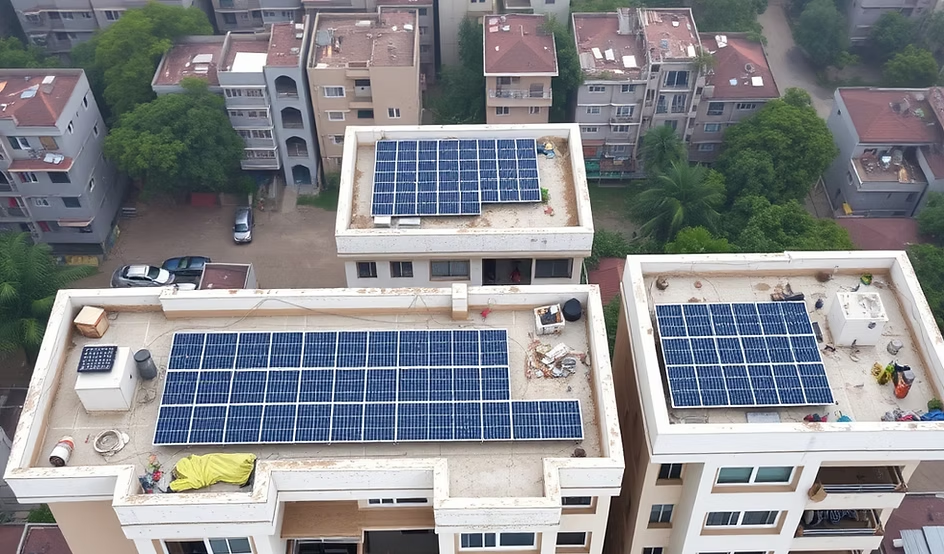
As electricity bills surge past ₹5,000 a month for large villas, Bangalore's villa owners are turning sunlight into their smartest financial asset.
Gone are the days when Bangalore used to have a long monsoon season. Based on data from the past 2 years, Bangalore receives over 300 sunny days a year. Your villa's rooftop is, quite literally, a power plant you haven't switched on yet. In 2026, with government subsidies covering a meaningful share of costs and electricity tariffs up roughly 30% over the last 3 years, there has never been a better — or more urgent — time to go solar.
Why Your Electricity Bill Keeps Climbing
Walk through any villa in Whitefield or Sarjapur Road today and you'll find a home that barely resembles what it was a decade ago. Two or three inverter ACs running through the night. An induction cooktop and an air fryer sharing counter space with a microwave and an OTG. A dishwasher. A washing machine with a dryer. A home theatre. Smart lighting. Security cameras running 24/7. And then there's the electric vehicle charging at night — drawing anywhere between 7 to 15 units in a single overnight charge.
The BESCOM slab jumps from ₹5.50 to ₹7.45 per unit once consumption crosses 200 units per month — and a modern villa with all the above can easily consume 400–700 units monthly. That's bills north of ₹8,000–₹12,000 every month, and rising.
Higher load vs 2015 villas
Units/month avg. large villa
Peak monthly BESCOM bills
Per EV overnight charge
The culprits: multiple ACs (each 1.5-ton unit consumes roughly 100–120 units/month), EV home charging which can add 200–300 units monthly, modern kitchen appliances, and the ever-expanding array of consumer electronics — gaming PCs, smart TVs, robot vacuums, and home automation hubs.
“Solar doesn't just cut your bill — it puts a permanent ceiling on how high it can ever go.”
What Does Solar Installation Actually Cost in 2026?
For a typical Bangalore villa, the recommended system size ranges from 5 kW to 10 kW, depending on your consumption and available rooftop space. A 5 kW system covers roughly 300 sq. ft. of roof and can meet the needs of a moderately equipped villa. A 10 kW system is better suited for large villas with multiple ACs and an EV charger.
| System Size | Cost Before Subsidy | After Subsidy | Best For |
|---|---|---|---|
| 3 kW | ₹2.20 – ₹2.4 lakh | ₹1.40 – ₹1.60 lakh | 2BHK villa / low consumption |
| 5 kW | ₹3.15 – ₹3.3 lakh | ₹2.35 – ₹2.5 lakh | 3–4BHK villa, 2 ACs |
| 7 kW | ₹4.50 – ₹4.65 lakh | ₹3.65 – ₹3.80 lakh | Large villa, 3 ACs + EV |
| 10 kW | ₹6.10 – ₹6.30 lakh | ₹5.30 – ₹5.50 lakh | Premium villa, full electrification |
The Government Subsidy: Real Money Back in Your Account
The headline act in 2026 is the PM Surya Ghar: Muft Bijli Yojana. This isn't a rebate on paper — the Central Financial Assistance (CFA) is credited directly to your bank account within 30 days of your system being commissioned and registered on the national portal.
For first 2 kW
For 2–3 kW
Max subsidy (3 kW+)
Karnataka does not offer an additional state subsidy for residential rooftop solar in 2026, but the central scheme alone is substantial. For any system 3 kW and above — which covers the vast majority of villa installations — the maximum central subsidy is fixed at ₹78,000. For a typical 5 kW system costing ₹3.3 lakh, this means roughly 25% back in your account. Apply via the National Portal for Rooftop Solar (pmsuryaghar.gov.in) with your BESCOM consumer number.
Additionally, Group Housing Societies and RWAs in Bangalore's gated villa communities can claim ₹18,000 per kW for shared common-area installations up to 500 kW — making community solar projects in large township villas exceptionally attractive.
Return on Investment: When Does It Pay Back?
With BESCOM tariffs increasing year-on-year and solar panel costs declining, the payback window has compressed dramatically in Bangalore. For a high-consumption villa running multiple ACs and an EV charger, the numbers look compelling.
5 kW System payback
7 kW System payback
10 kW System payback
Post-payback, the system continues generating for 20–25 years with minimal maintenance. Net metering with BESCOM also means excess generation is fed into the grid and credited against your bill — effectively making your meter spin backwards on sunny afternoons.
Bangalore Localities Leading the Solar Charge
Solar adoption across Bangalore's villa belts has been uneven — concentrated where tech-sector homeowners, higher electricity consumption, and larger rooftop real estate converge:
- Whitefield & ITPL Corridor
- Sarjapur Road
- Electronic City & Begur
- Hebbal, Yelahanka & North Bangalore
- Jayanagar & JP Nagar
- Bannerghatta Road & Kanakapura
Should You Install Solar in 2026?
If your villa's monthly bill is above ₹4,000 — and for most modern Bangalore villas it is — the answer is almost certainly yes. The combination of falling hardware costs, a government subsidy directly credited to your account, rising BESCOM tariffs, net metering benefits, and the additional load from EV charging has created the most favourable economic conditions for solar in Bangalore's history.
Ask for both on-grid and hybrid (battery backup) options. Verify that the vendor handles the BESCOM net metering application and PM Surya Ghar subsidy paperwork — the best installers include this as part of their end-to-end service.
Your roof gets about 5.5 peak sun hours a day in Bangalore. That's roughly 2,000 hours of free power generation per year. Whether you're charging your EV, running three ACs, or simply tired of dreading your monthly BESCOM bill — the sun has already done the hard work. It's waiting for you to install the panels.
Client testimonials of Aura Energy
“After evaluating a couple of vendors, I decided on opting for Aura Energy. Their approach of no-sales, pure guidance stood out. The bescom net-metering process was completed within a week & I also received my subsidy in 2 weeks. The installation was very clean and customised as per my Villa”
Grp. Captain Partha Sarkar
Assetz Earth & Essence / NVT Stopping by the Woods
“I got a 6.2Kw solar with Adani top-conn panels installed at my home. The costing I received was very good & my family loved the installation. The Aura Energy Team is very professional and finished the work in just 2 days. My solar plant is producing almost 900 units in a month and we are very happy.”
Manoj Karn
Prestige City Sarjapura road
Verdict
The Numbers Are in Your Favour
2026 snapshot
A 5 kW solar system in Bangalore costs under ₹2.5 lakh after subsidy, saves ₹4,000–₹8,000 per month, and pays for itself in under 4.5 years — then generates free power for two more decades.
How to apply
Ready to choose the right system?
Talk to Aura Energy for a free villa assessment — we'll walk you through On-Grid vs Hybrid, subsidy paperwork and BESCOM net-metering.