
On-Grid vs Hybrid Solar for Your Bangalore Villa
Bangalore gets over 300 sunny days a year — but before you sign, one decision shapes your savings and subsidy for 25 years: On-Grid or Hybrid?
Anant Sharma · Jul 1 · 6 min read
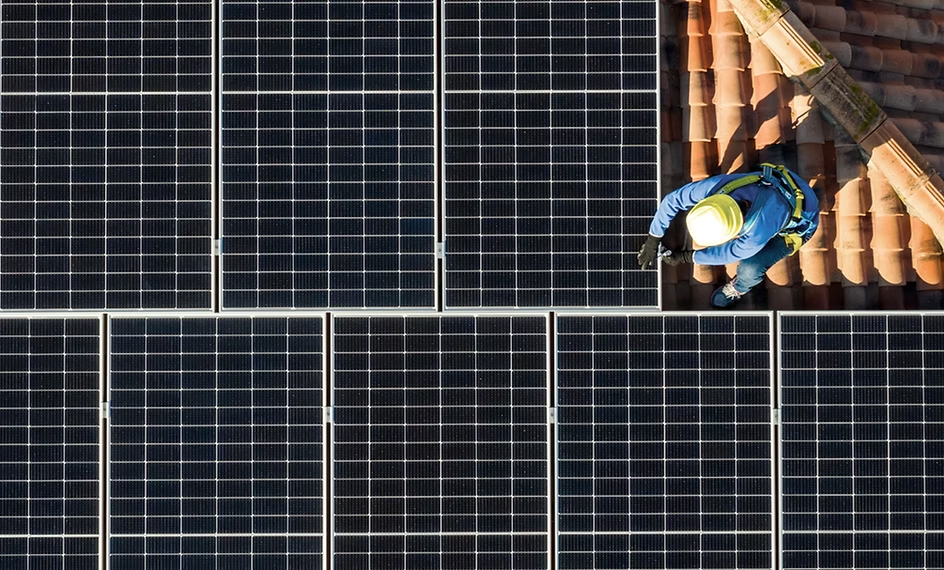
Bangalore gets over 300 sunny days a year, making it one of India's best cities for rooftop solar. But before you sign a contract, one decision will shape your savings, your subsidy eligibility, and your experience for the next 25 years: On-Grid or Hybrid?
For villa owners, this choice is especially significant. A villa typically has larger roof area, higher power consumption (pumps, air conditioning, EV charging, common lighting), and — in many layouts — a dependence on uninterrupted power for water supply. This guide breaks down everything you need to know.
Understanding the Two Systems
On-Grid Solar
Panels generate electricity during the day. Your home uses what it needs, and surplus flows back into BESCOM's grid via a net meter. At night, you draw from the grid as usual. No batteries involved.
Also called: Grid-tied, Grid-connected
Hybrid Solar
Panels generate electricity, excess is stored in lithium-ion batteries. The home uses solar first, then battery backup, and draws from the grid only when both are depleted. Stays connected to the grid.
Also called: Grid-tied with battery backup
On-Grid Solar — Pros & Cons
The most popular choice in Bangalore. Simple, cost-effective, and fully subsidy-eligible.
Advantages
- ✓Lowest upfront cost — No batteries means 30–40% lower installation cost compared to hybrid.
- ✓Full subsidy eligible — Qualifies for up to ₹78,000 under PM Surya Ghar Muft Bijli Yojana.
- ✓Net metering credits — Surplus units fed into BESCOM's grid are credited against your bill, often bringing monthly bills close to zero.
- ✓Low maintenance — No batteries to replace or monitor. Annual panel cleaning is typically all that's needed.
- ✓Faster ROI — With lower system cost and full subsidy, payback is typically 4–6 years for villas.
- ✓30-year panel life — Modern TopCon bi-facial panels are warrantied for 30 years output performance.
Disadvantages
- ✗No backup during outages — If BESCOM cuts power, your solar system also shuts down (safety requirement). This is the #1 complaint in Bangalore.
- ✗Daytime-only generation — Solar only works when the sun is out; all night consumption is from the grid.
- ✗Grid dependency — Your savings are tied to BESCOM tariff rates, which can change.
Hybrid Solar — Pros & Cons
The premium solution — ideal if power cuts are a real pain point in your area or if energy independence is a priority.
Advantages
- ✓Power backup during outages — Battery keeps essential loads running even when BESCOM is down — lights, fans, internet, fridge, water pump.
- ✓Better self-consumption — Instead of exporting cheap surplus to the grid, you store it and use it at night when grid power is expensive.
- ✓Subsidy still available — Since the system stays grid-connected, it qualifies for PM Surya Ghar subsidy (the grid-tie component).
- ✓Future-proof — As EV adoption grows, stored solar can charge your vehicle cheaply at night.
- ✓Works during load-shedding — Highly relevant in outer Bangalore layouts like Sarjapur, Devanahalli, Whitefield outskirts where cuts can last 2–4 hours.
Disadvantages
- ✗Higher upfront cost — Adding lithium-ion batteries increases total system cost by ₹1–2 lakh or more for a villa-sized system.
- ✗Battery replacement cost — Lithium batteries last 8–12 years. Budget for a replacement cycle during the system's 25-year life.
- ✗More complex installation — Hybrid inverters require more configuration and a slightly longer installation timeline.
- ✗Longer payback period — The added battery cost typically extends ROI to 6–7 years.
The Subsidy Story: This Is Where It Really Matters
Under the Government of India's PM Surya Ghar: Muft Bijli Yojana — launched in February 2024 — residential homeowners can receive direct subsidy of up to ₹78,000 credited directly to their bank accounts. Here's the subsidy slab and eligibility by system type:
| System Capacity | Central Subsidy (CFA) | On-Grid | Hybrid | Off-Grid |
|---|---|---|---|---|
| Up to 2 kW | ₹30,000/kW (max ₹60,000) | Yes | Yes* | No |
| 3 kW | ₹78,000 (flat) | Yes | Yes* | No |
| Above 3 kW (e.g. 5–10 kW) | Capped at ₹78,000 | Yes | Yes* | No |
Key takeaway for villa owners: Whether you go On-Grid or Hybrid, you qualify for the same subsidy amount. The subsidy does not cover the battery bank — but it does cover panels, inverter, and grid-tied components. An Off-Grid system gets nothing from the government.
For a typical villa requiring a 5–10 kW system, the subsidy is capped at ₹78,000 regardless. It is credited via Direct Benefit Transfer (DBT) directly to your bank account, typically within 15–30 days after BESCOM inspection and portal submission.
Cost Comparison: What Does a Bangalore Villa Actually Pay?
Assuming a typical 5 kW rooftop system for a 3–4 BHK villa consuming 600–800 units/month:
On-Grid 5 kW
Total cost: ₹3.2 – 3.4 lakh
Subsidy: −₹78,000
Net cost: ~₹2.5 – 2.7 lakh
Monthly savings: ₹3,000 – 5,000
Payback period: 4–5 years
Hybrid 5 kW
Total cost: ₹5.0 – 5.2 lakh
Subsidy: −₹78,000 (grid component)
Net cost: ~₹4.2 – 4.4 lakh
Monthly savings: ₹4,000 – 6,500
Payback period: 6–8 years
Bangalore-Specific Factors to Consider
Solar irradiance
Bangalore receives around 5.5 peak sun hours per day on average — excellent for solar. Even monsoon months (June–September) still see reasonable generation thanks to diffuse light from cloud cover.
Power cut situation
Central Bangalore areas (Indiranagar, Koramangala, JP Nagar) see very few outages — under 2 hours a month. For these locations, an on-grid system is almost always sufficient. However, villas in newer layouts — Sarjapur Road, Devanahalli, Kanakapura Road, Electronic City outskirts — can experience 2–6 hours of load-shedding daily, especially in summer. Here, hybrid battery backup pays for itself in comfort and convenience.
Villa roof size
A standard independent villa in Bangalore has 1,500–3,000 sq. ft of roof area — comfortably accommodating 8–15 kW of solar capacity. You are unlikely to face the roof space constraints that apartment dwellers do.
Water pump & borewell loads
Many Bangalore villas rely on sump and overhead tanks. If your pump motors run during power cuts, hybrid solar becomes very practical — it keeps the water supply running without needing a separate inverter-UPS setup.
BESCOM net metering
BESCOM supports net metering for rooftop solar. Excess units exported are credited at ₹2.50–3.00/unit. Given that BESCOM's retail tariff is ₹6–9/unit for villas, you're better off consuming solar directly than exporting — which is another argument for hybrid storage in high-consumption homes.
Verdict
Our Verdict for Bangalore Villas
Go On-Grid if:
Your area has reliable BESCOM supply with rare outages, your priority is maximum savings with minimum investment, and you want the fastest payback. The ₹78,000 subsidy makes it genuinely affordable. This is the right choice for most villas in central and south Bangalore.
Go Hybrid if:
You live in an outer layout or growth corridor with frequent power cuts, you have critical loads (medical equipment, water pumps, home office), you're already investing ₹3–5 lakh in a separate inverter-UPS setup (consolidate it into solar), or you're installing an EV charger and want free overnight charging from stored solar.
Avoid pure Off-Grid:
Unless your villa is in a genuinely remote area with no grid connection, pure off-grid systems are expensive, grant-ineligible, and unnecessarily complex for urban Bangalore.
Final Checklist Before You Decide
1. How often does your area face power cuts?
Less than 4 hrs/month: On-Grid is fine. More than that: consider Hybrid.
2. Do you have critical loads that can't tolerate outages?
Borewell pump, medical equipment, home server: Hybrid is worth the premium.
3. Do you already own an inverter-UPS?
If yes, a hybrid solar system can replace it entirely, justifying the extra cost.
4. What is your budget?
Net cost after subsidy: On-Grid ~₹2.5–2.7L; Hybrid ~₹4.2–4.4L for a typical 5 kW villa system.
5. Are you planning an EV?
Hybrid + home charger = almost free fuel from stored solar overnight.
Both systems are excellent investments for a Bangalore villa. The subsidy makes On-Grid a near no-brainer if your grid is reliable. Hybrid adds comfort and resilience at a premium — and in Bangalore's booming outer suburbs, that premium is often worth every rupee.
How to apply
Ready to choose the right system?
Talk to Aura Energy for a free villa assessment — we'll walk you through On-Grid vs Hybrid, subsidy paperwork and BESCOM net-metering.